
Last time, we discussed why Squirrels are the ultimate ‘Decentralized Warehouse’ managers. But what happens when storage itself becomes a liability? Welcome back to the SCM Meets The Wild series. Today, we’re trading the forest for the North Atlantic to learn about Cross-Docking from the Puffin.
A squirrel burying nuts is practicing Traditional Warehousing—long-term storage, which comes with a risk of loss, theft, and damage due to uncertainties. But for the seabirds of the North Atlantic, this is not a problem, as they follow a different strategy. They operate on a high-velocity, low-buffer model known in the logistics world as Cross-Docking.
Bypassing The Need for Storage
In a standard supply chain, goods move into a warehouse, are ‘put away’ into racks, and wait to be shipped out. This creates Inventory Carrying Costs—the ‘rent’ you pay for every day a product is stored and sits still in your warehouse.
Cross-docking eliminates the ‘wait’. It is specifically for companies that prioritize speed of delivery and high inventory turnover. It is a lean logistics practice where inbound materials are unloaded from an arriving carrier and loaded directly into outbound carriers with little to no storage in between.
The Puffin’s ‘Terminal’ Beak
The Puffin is nature’s premier cross-docking specialist. Unlike a pelican that swallows its catch (processing/storage), a Puffin uses a specialized serrated beak to hold up to 60 small fish crosswise.
- Inbound Consolidation: A puffin collects fish (goods) from various points of the ocean (Suppliers).
- Sorting Hub: The beak acts as a staging area. The fish aren’t digested or stored in a burrow (Warehouse). They are merely held in transit.
- Outbound Distribution: The moment the bird lands, the ‘goods’ are directly transferred to the babies—Pufflings (End-consumers)—to minimize handling time and prevent spoilage.
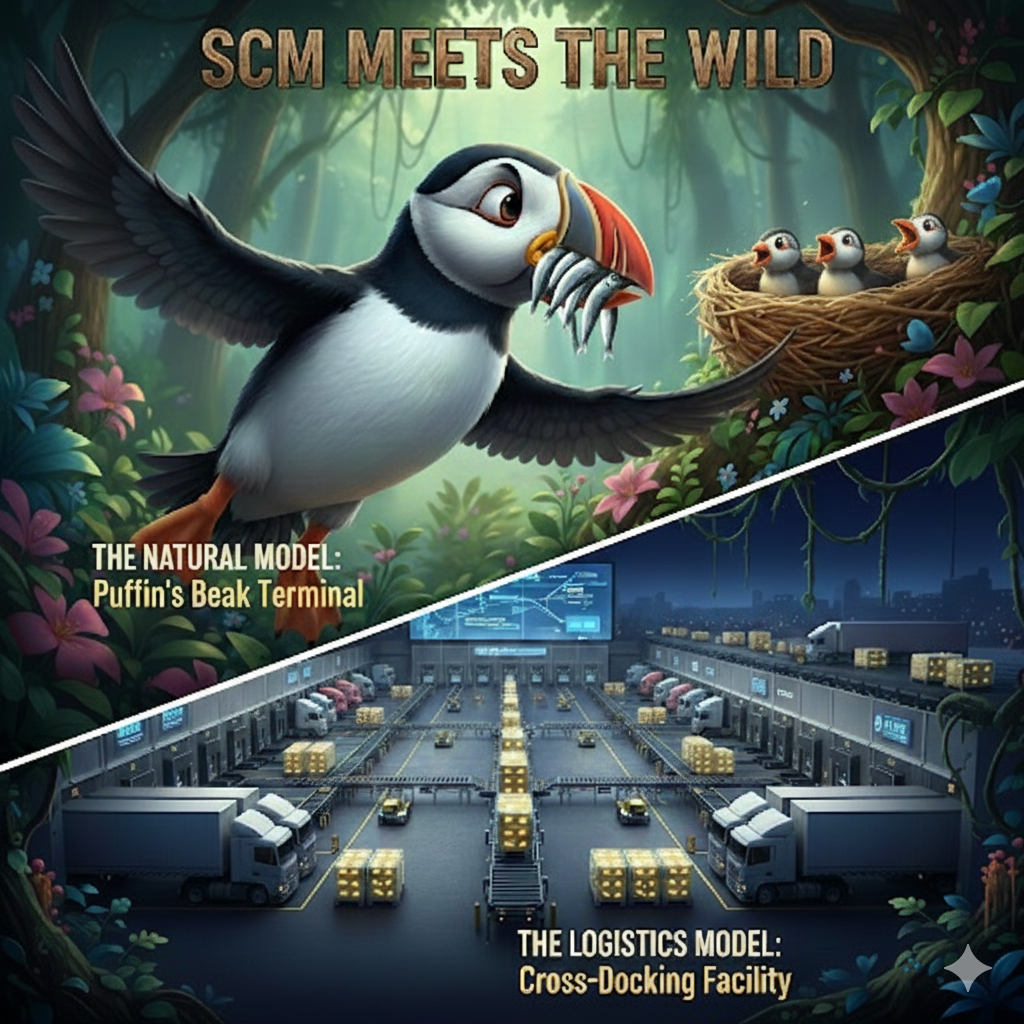
AI-Generated Image
The Walmart Masterclass
We cannot talk about cross-docking without mentioning Walmart, the retail giant that turned this puffin-like strategy into a global competitive advantage.
In the 1980s, Walmart revolutionized retail by bypassing third-party wholesalers. They used cross-docking to move goods from supplier trucks directly to store-bound trucks at their distribution centers. Today, Walmart reportedly cross-docks majority of its merchandise. By keeping goods in the distribution center for less than 24 hours, they achieve:
- Cost Leadership: Massive savings on labor and storage “rent,” which they pass to customers as “Everyday Low Prices.”
- Lightning Speed: Fresher groceries on shelves faster than competitors.
How Can We Master Cross-Docking?
If your business requirement is to reduce storage costs or faster shipping and receiving, and you want to implement cross-docking successfully, a supply chain manager must master three technical pillars:
1. Integration of Information (The ‘Call’)
In a traditional warehouse, you have the luxury of time to figure out what’s in a box once it arrives. In cross-docking, you don’t.
- The Tech: You must use Advanced Shipping Notices (ASN) and EDI (Electronic Data Interchange).
- The Goal: The facility must know exactly what is on the inbound truck before it hits the gate. This allows the Warehouse Management System (WMS) to assign a destination dock immediately.
- The Puffin Lesson: Just as a Puffin knows exactly where its hungry chicks are before it leaves the ocean, a manager must have total ‘In-Transit Visibility.’
2. Minimizing the ‘Touch’ (Velocity over Volume)
Every time a human or a forklift interacts with a product, the ‘tax on time’ increases.
- Traditional Path (6-8 touches): Unload → Identify → Move to Rack → Store → Pick → Sort → Stage → Load.
- Cross-Docking Path (2 touches): Unload → Move directly to Outbound Truck.
- The Result: By cutting out the ‘Put-away’ and ‘Picking’ steps, you eliminate the two most labour-intensive and error prone parts of warehousing.
3. Facility Design
You cannot cross-dock effectively in a square, deep warehouse designed for storage.
- The Design: Master facilities are often shaped like an ‘I’ or a ‘T’. This maximizes the “perimeter-to-floor-space” ratio.
- The Metric: You are optimizing for Dock-to-Dock time. The goal is for the product to travel the shortest possible physical distance from the North door (Inbound) to the South door (Outbound).
The Reality Check: Cross-Docking Challenges
While the Puffin makes it look easy, cross-docking is a high-wire act. If you want the speed, you must manage the risks:
- Heavy Upfront Investment: You need a sophisticated fleet and high end Warehouse Management Systems to track everything in real time.
- Supplier Dependability: If a supplier is late by even an hour, the outbound truck sits empty, and the entire ‘fast-move’ chain breaks.
- Volume Requirements: Cross-docking only becomes cost-effective when you have high volumes of goods moving daily. Low volume makes the logistics coordination more expensive than simple storage.
Conclusion
If your company operates in fast-moving industries where every second increases the risk of spoilage or obsolescence, you cannot afford to be a squirrel.
By adopting the Puffin’s ‘cross-docking’ mindset, you transform your logistics from a stagnant cost center into a high-velocity engine. Stop storing, start moving, and let your supply chain take flight.
That’s all for this installment. In the next article of the SCM Meets The Wild series, we will dive into the world of 3PLs (Third-Party Logistics) and how nature’s most effective collaborators get the job done.