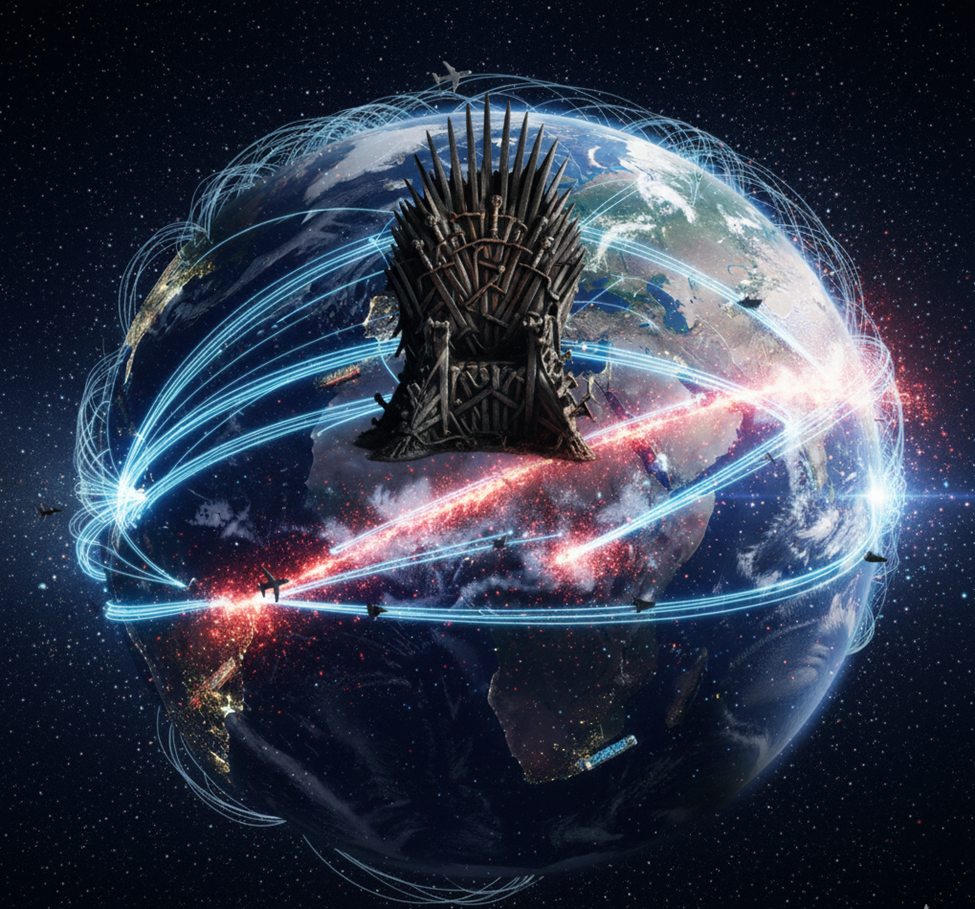
For decades, the global supply chain was the world’s most diligent and unassuming worker. We ensured the pipes flowed, goods moved, and the global economy hummed along – efficient, invisible, and utterly taken for granted. Efficiency was our primary goal, and “Just-in-Time” was our standard operating procedure. But if Davos 2026 taught us anything, it is that those days are over. A far more aggressive reality is taking shape. The quiet hum has been replaced by the clatter of steel.
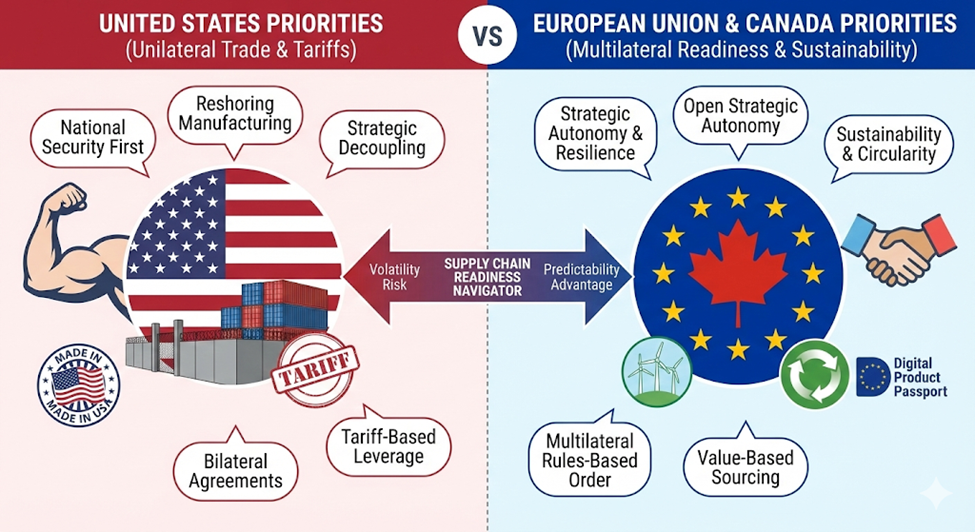
The World Economic Forum (WEF) didn’t just discuss “resilience” this year; they subtly, yet definitively, unveiled a new global playbook where trade is the weapon and the supply chain is the battlefield. This isn’t just about tariffs anymore; it is about altering the very fabric of the new world order, stretching from the most basic element, water, to the most sophisticated finished goods, silicon chips. The proceedings, policy announcements, and keynote sessions exposed a transatlantic rift between traditional allies – the US and the EU (with Canada notably supporting the European shore). While the jibes and retaliations between world leaders were one for the ages, the deeper message from the WEF was clear: through the formal launch of its Manufacturing and Supply Chain Readiness Navigator and new Blue Economy mandates, the forum signaled that disruption is now a permanent condition and resilience is the primary growth driver.
Additional read – Global Geopolitical context – Atlantic Council’s summary of Davos 2026
Finance and Supply Chain practitioners must study this shift closely. Their roles are now transcending the traditional buying and warehousing functions and ascending into the strata of
- Geopolitical strategic advisory
- Economic diplomacy
- AI expertise
The stage is now set for a new world order.
Part 1: Davos’s 2026 Silent Declaration: End the Hegemony, promote the Autonomy
The US Play: President Trump dominated Davos by employing what some termed “Supply Chain Chokehold“. He threatened 10–25% tariffs on eight European countries unless they facilitated a US purchase or control of Greenland. From the European perspective, this was not about rogue states; it was the US weaponizing its own market access to coerce its NATO allies. While President Trump also announced a “framework deal” in his special address, it got sidelined and the damage to Transatlantic Trust was already cited by EU leaders as a reason to fast-track European Strategic Autonomy.
- The European Counter-Weapon: In response, EU leaders (like Emmanuel Macron and Mark Carney) discussed using the “Capital Weapon” – hinting that Europe could retaliate by dumping US Treasuries or restricting US access to European capital markets.
- The WEF’s Role: The WEF’s Readiness Navigator and Blue Economy policies are, in many ways, an attempt by the “global establishment” to standardize the rules so that no single leader can unilaterally “turn off the tap.” It is a defensive move to maintain a rules-based system when the US appears intent on breaking it.
To understand how effective WEF’s role can be in deciding the new World order, it is important to understand,
- Manufacturing and Supply Chain Readiness navigator: The new Sourcing Decalogue
This is the heart of this new system. Imagine it as a new “national credit score,” evaluating 130+ countries across seven critical factors. This isn’t about military might; it’s about the deep connections a nation can have with its trade partners, the ability to be a reliable, sustainable, and predictable partner.
The navigator doesn’t just look at “Can you build it?” but “Will the lights stay on and will the borders stay open?“
| Readiness Factor | What is being measured? | Why it targets US/Superpower dominance |
| Geopolitical Balance | The country’s neutrality and freedom from “Trade Weaponization.” | The US Risk: High volatility due to unilateral tariffs and “America First” rhetoric. |
| Energy Security | Reliable, diversified, and green energy mix. | The Pivot: Rewards countries like Sweden or India (solar/wind focus) over oil-dependent nations. |
| Regulatory Coherence | Predictability of laws and trade rules. | The Check: Penalizes countries that change trade rules on short notice via social media or executive order. |
| Skilled Talent | Workforce trained in AI and automation. | The Shift: Focuses on future skills, where emerging hubs are investing heavily. |
| Tech/Innovation | Ability to host “Agentic AI” and advanced manufacturing. | The Equalizer: Tech is no longer just a US/China game; regional tech hubs are scaling. |
| Sustainability Ambitions | Commitment to “Planetary Boundaries” (Water/Carbon). | The Trap: Forces the internalized cost of nature into the business model. Here is where Blue Economy comes into play. |
| Reliable Infrastructure | Traditional logistics (ports) + Digital (5G/6G). | The Base: Foundation for “Real-time” supply chain orchestration. |
- WEF’s authority to enforce (actually, the soft power to influence)
The WEF itself doesn’t have an enforcement arm. They won’t send an army to fine a corporation. Their power, however, is far more insidious: soft influence through global financial markets. The WEF partners with major consulting firms (like Kearney, Accenture) and the Big Four auditors. These firms, in turn, advise the world’s largest institutional investors (who control trillions of dollars). When the WEF declares “Shadow Pricing” for water a best practice, those investors start demanding to see these numbers.
Shadow Pricing isn’t a real cost; it’s a hypothetical one. It asks: “What if water did cost $10 a gallon?” Companies that transparently report high “Shadow Prices” for their water usage in manufacturing are immediately flagged as having higher future risk. Their stock may drop, or their Cost of Capital (the interest they pay on loans) will increase. Conversely, companies actively reducing their water footprint get “Green Financing” and lower rates.
In Nudge, Thaler and Sunstein highlight how the Toxics Release Inventory transformed industry behavior not through heavy-handed laws, but through the “nudge” of transparency and social pressure. By simply requiring companies to report their pollution levels publicly, nations were nudged into a “race to the top” to avoid the stigma of being the worst polluter. Similarly, the WEF’s new “Readiness Score” acts as a global leaderboard, nudging nations to compete for capital by being the most transparent and sustainable.
- How this “Checks’ US Authority?
“While Washington plays Geopolitical Chess, the WEF has released a new Scorecard—and for the first time, ‘Power’ is being outscored by ‘Predictability.’ Here is why your next CAPEX decision shouldn’t be based on a flag, but on a ‘Readiness Factor’ “
In the 2026 rankings, the US finds itself in a paradoxical position. While it has the highest innovation capacity, it is being “downgraded” in Geopolitical Balance and Regulatory Coherence (The consistency and transparency of a nation’s laws. Again, this gently penalizes nations where policies can shift rapidly based on political whim, rather than predictable legal frameworks).
- The US “Risk Premium”: Because the US has weaponized its own trade access (the “Greenland Crisis” or sudden tariffs), Finance departments are assigning a higher risk premium to US-based manufacturing. The WEF Navigator essentially “red-flags” the US for being unpredictable.
- India’s “Readiness” Surge: India is the “Sleeping Giant” of this summit. By aligning its national policies with the WEF’s 7 factors -investing in Green Energy and Skills Accelerators – India is positioning itself as the “Stable Alternative.”
- The Rebalancing Effect: If a CFO sees that India has a higher “Regulatory Coherence” score than the US this year, they may choose to move a Global Capability Center (GCC) to Hyderabad instead of Texas. The WEF has effectively turned “Stability” into a currency that emerging markets can print.
The summit pushed the idea of “Trust as the new currency.” If the US breaks trust through unilateral action, its “Trust Score” drops, leading to capital flight toward countries that play by the WEF’s multi-lateral rules.
- Sustainability Ambitions (The Blue Economy Factor): A nation’s commitment to “Planetary Boundaries,” particularly water and carbon. This is where the Global South finds its new voice. Nations with pristine coastlines, abundant freshwater, and aggressive green energy policies (think Indonesia’s marine ecosystems or Sweden’s green energy grid) score higher. It’s a direct counter to the historically resource-intensive, high-consumption lifestyles of developed economies like the US and EU.
- Do these Trade/Economic leverages really work?
A Brief History of SCM as a Battleground
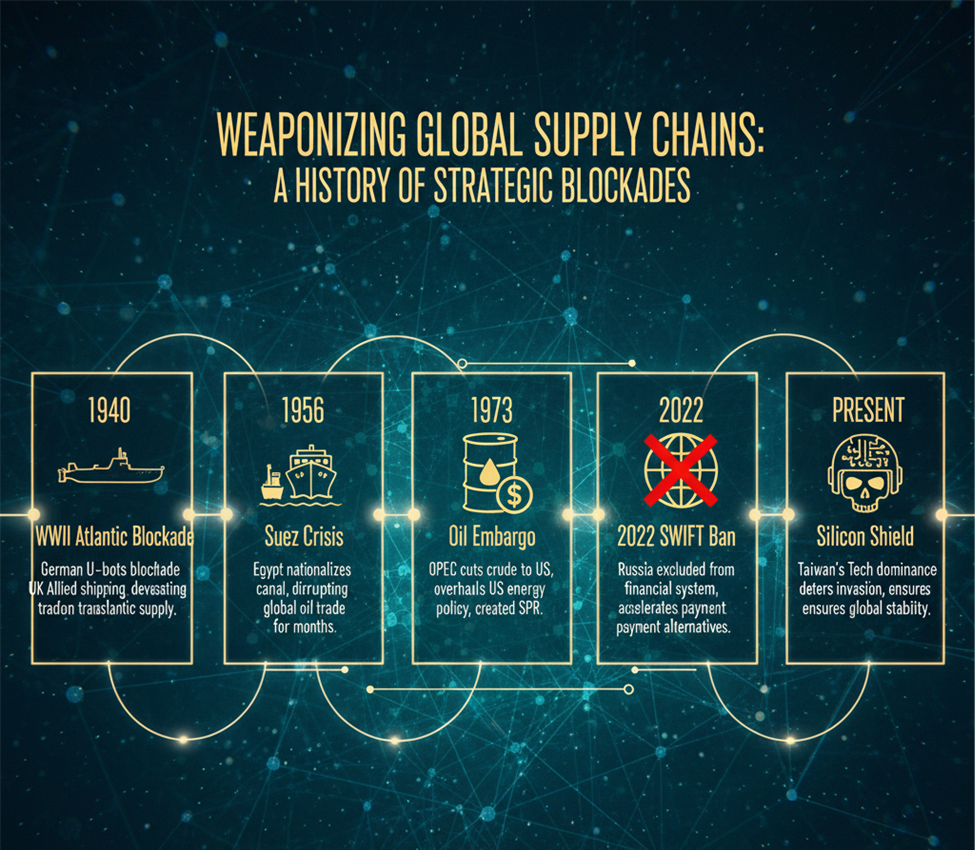
This isn’t the first time the world’s quiet plumbing has been weaponized. History is rife with instances where supply chain leverage became the decisive factor in geopolitical struggles.
- The 2024-25 Red Sea Crisis: Choke Point Economics. Recent memory gives us the Houthi attacks in the Red Sea. They effectively turned the Suez Canal, one of the world’s most critical maritime chokepoints, into a no-go zone. This wasn’t about conquering territory; it was about weaponizing a shipping lane. Trivia: The resulting rerouting of 15% of global maritime trade around the Cape of Good Hope added roughly $1 million per journey in fuel and time, causing inflation spikes and highlighting the fragility of globalized logistics.
- Taiwan’s “Silicon Shield”: The Ultimate Deterrent. Taiwan’s dominance in advanced semiconductor manufacturing (via TSMC) has inadvertently created a “Silicon Shield.” Any military action against Taiwan wouldn’t just be a regional conflict; it would unleash a global economic catastrophe by cutting off the microchips essential for everything from smartphones to fighter jets. Trivia: The sheer scale of investment in a single advanced chip fab (tens of billions of dollars) creates a powerful, self-reinforcing deterrence, binding global powers to Taiwan’s stability.
- The 2022 SWIFT Ban: The Financial Decoupling. When Russia invaded Ukraine, Western powers cut off Russian banks from SWIFT, the global financial messaging system. This was the ultimate weaponization of financial plumbing. Trivia: While it caused significant pain, it also accelerated the “de-dollarization” trend, pushing nations like China and India to develop their own financial messaging (CIPS) and payment systems (UPI) to bypass Western control, ironically creating more fragmentation.
- 1973 Oil Embargo: The Crude Awakening. Following the Yom Kippur War, Arab OPEC members cut off oil supplies to the US and its allies. This wasn’t a battle fought with tanks; it was a battle fought with flow rates. Gas lines stretched, economies reeled, and the US was forced to fundamentally shift its Middle East policy and energy strategy. Trivia: This crisis led directly to the creation of the Strategic Petroleum Reserve, a testament to the fact that controlling the flow of a commodity is as potent as any military might.
And many more such instances even before these
Part 2: Davos’s 2026 loud call for action: redistribution of wealth by splitting the global stakes
While it is easy to view these new policies solely as a means to curtail global bullies, they do give promoting fair practices a real opportunity. Practices that our world needs in abundance today.
The Blue Economy, for instance, exemplifies rebalancing. For centuries, global trade was dictated by those who controlled the shipping lanes – a domain dominated by powerful navies. But the Blue Economy shifts the focus from maritime control to oceanic health and coastal assets. Consider the smaller island nations or coastal states in the Global South. Historically, they were just dots on a map. Now, by monetizing their coral reefs (for carbon sequestration), their mangroves (for coastal protection), and their sustainable fisheries, they can issue Blue Bonds or sell Blue Carbon Credits. This allows them to fund their own development without solely relying on loans from traditional powers. It gives them a new form of Blue Sovereignty, turning ecological stewardship into economic power. It essentially says: “You want to consume? You need healthy oceans. We own the healthy oceans. Pay us.”
Similarly, this shift encourages developing countries like India, Vietnam, and others. Historically, these countries have been penalized for their ‘delayed’ industrialization, inheriting the environmental consequences and Greenhouse effect debt due to the West’s earlier growth. Now, they are incentivized to invest in predictability, trust, and sustainability. By actively improving their Readiness Score – building world-class green energy infrastructure and transparent regulatory frameworks – these nations can attract capital that is now actively fleeing the volatile trade wars between traditional powers.
Part 3: Speculating the End-Game
How does this play out? There are three likely scenarios for the near future:
- The Regional Fortress (High Likelihood): Global trade fragments into “Sovereign Stacks.” The US, EU, and BRICS+ each operate their own separate, non-overlapping supply chain ecosystems to insulate themselves from weaponized trade.
- The Sustainability Shield (Medium Likelihood): Environmental “Readiness” becomes the ultimate non-tariff barrier. Nations that cannot meet the “Blue Davos” standards are effectively ghosted by global capital, creating a new “Green Wall” between developed and developing nations.
- The Tech-Diplomacy Era (Medium Likelihood): “Agentic AI” takes over the execution layer of SCM. Trade wars are fought not with tariffs, but through algorithmic blockades, where AI “Agents” are programmed to automatically bypass specific unfriendly jurisdictions.
The most desired outcome, however, is one where large developing countries embrace this model – integrating sustainability, human development, trust, and cooperation into their growth journeys. This creates a model that keeps humanity and nature at the center. This Summit has definitely nudged such nations to think in that direction.
In The Infinite Game, Simon Sinek argues that in the global arena, there is no such thing as “winning.” There are only those who drop out and those who keep playing. When nations act on “whims and fancies,” they play a finite game that ends in exhaustion. By shifting toward sustainability and transparency, they move toward an “Infinite Mindset,” where the goal is not to beat a neighbor, but to build a system resilient enough to stay in the game forever.
The theme of Davos 2026, ‘The Spirit of Dialogue,’ is thus appropriately named. It reminds us that the only way to sustain an infinite game is through the very thing that stops a whim from becoming a war: a seat at the table and the courage to talk.
But for now, the key takeaway for us is that the days of the invisible supply chain are over. We are no longer just plumbers; we are the engineers of a new world order, wielding the quiet power of predictability, sustainability, and trust as the sharpest swords in the trade battleground. Understanding this shift isn’t just about business continuity; it’s about discerning the strategic currents that will reshape our world.
Leave a Reply